Google Marketing Live 2026: Complete Guide to AI Advertising, Search & Marketing Automation
Google Marketing Live 2026 Just Redefined Digital Marketing
Google Marketing Live 2026 was not just another annual product event. It marked a major turning point in the future of digital marketing, AI advertising, ecommerce, and search.
For years, marketers have been hearing about AI-powered automation, machine learning optimization, and conversational search. But at GML 2026, Google officially showed how deeply artificial intelligence is becoming integrated into every stage of the customer journey — from discovery and engagement to conversion and long-term attribution.
- AI-driven advertising systems designed for instant consumer intent parsing
- Conversational search experiences that reshape natural user interactions
- Agentic marketing assistants executing campaigns with minimal manual inputs
- AI-generated creative workflows using Gemini Omni & Veo
- Universal shopping experiences that track items across all of Google
- Predictive measurement models projecting values up to 6 months in advance
- Cross-platform commerce infrastructure reducing checkout friction to zero
The biggest shift is clear: marketing is moving from manual campaign management toward AI-assisted decision-making at scale.
For businesses, agencies, ecommerce brands, and SEO professionals, these updates are more than feature announcements. They represent a structural change in how customers discover information, interact with brands, and make purchasing decisions online.
In this complete guide, we’ll break down the most important announcements from Google Marketing Live 2026 and explain what they actually mean for the future of SEO, paid advertising, AI marketing, and digital growth strategies.
What Is Google Marketing Live 2026?
Google Marketing Live (GML) is Google’s flagship annual event focused on Google Ads, Search innovation, AI advertising, Ecommerce technology, Analytics, Performance marketing, and YouTube advertising.
At GML 2026, Google focused heavily on artificial intelligence and introduced what it calls the “agentic era” of marketing.
Unlike traditional automation tools that follow preset rules, agentic systems actively analyze, recommend, optimize, and execute marketing tasks with minimal manual input. The foundation of this ecosystem is powered by Gemini 3.5 Flash.
The Rise of Agentic Marketing with Gemini 3.5 Flash
One of the biggest announcements at Google Marketing Live 2026 was the introduction of Ask Advisor, an AI-powered assistant integrated across Google’s marketing ecosystem. This system is powered by Gemini 3.5 Flash, Google’s latest high-speed AI model optimized specifically for complex, real-time marketing workflows.
What Is Agentic Marketing?
Agentic marketing refers to AI systems that can understand business goals, analyze campaign performance, make strategic recommendations, generate creative assets, optimize budgets, and automate complex tasks.
Instead of simply automating repetitive actions, agentic AI actively participates in decision-making.
For example, marketers can now ask conversational questions like:
- “Which campaign generated the highest-quality leads this month?”
- “Why did ROAS decrease last week?”
- “Generate new ad creatives for Gen Z ecommerce customers.”
- “Build a cross-channel performance report.”
The AI instantly responds with recommendations, visual reports, optimization suggestions, copy drafts, and forecasting insights. This dramatically reduces the time marketers spend digging inside heavy dashboards and spreadsheets.
Ask Advisor: Google’s New AI Marketing Assistant
Ask Advisor acts as a unified AI layer across Google Ads, Google Analytics, Merchant Center, and the Google Marketing Platform (GMP). The system is designed to simplify campaign management through conversational interactions.
Traditional digital marketing workflows are highly fragmented. Marketers often spend hours switching between analytics tools, ad dashboards, reporting systems, ecommerce repositories, and attribution platforms. Google's goal is to completely centralize these processes through AI-powered assistance. This could significantly improve productivity, campaign optimization speed, reporting efficiency, creative generation, and strategic decision-making.
For agencies managing multiple clients, this could become one of the biggest operational shifts in years, boosting productivity and allowing specialists to focus on strategy over setup.
Google AI Search: The Future of SEO Is Changing
Another major announcement at GML 2026 was the expansion of conversational AI search experiences. Google Search is rapidly evolving into what the company calls “AI Mode.”
Instead of typing short keywords, users are increasingly asking longer questions, conversational prompts, and contextual requests, such as:
- “What’s the best CRM for small ecommerce brands?”
- “Compare AI SEO tools for agencies.”
- “Best running shoes for flat feet under $150.”
Google’s AI systems now generate summarized responses directly inside search results. This has major implications for SEO.
How AI Search Will Impact Organic Traffic
Traditional SEO strategies focused heavily on keyword rankings, click-through rates, search volume, and featured snippets. But AI-powered search introduces new behavior patterns.
Users may increasingly get answers directly inside AI Overviews, conversational summaries, and AI-generated recommendations. While this could reduce clicks for low-value, simple informational content, it also creates massive new opportunities. Websites that provide expert analysis, original insights, authoritative content, structured answers, and semantic depth will become more valuable as core AI citation sources.
The Shift from SEO to AEO (Answer Engine Optimization)
One of the biggest marketing trends emerging from GML 2026 is the rise of AEO — Answer Engine Optimization. Instead of optimizing only for search engine crawlers, businesses must now optimize for AI Overviews, Gemini, ChatGPT, Perplexity, and other conversational AI systems.
| Feature | Traditional SEO | Modern AEO (Answer Engine Optimization) |
|---|---|---|
| Focus | Keywords, backlinks, and page structure | Semantic entities, conversational intent, and expert authority |
| Format | Long-form blog posts and simple landing pages | Concise definitions, FAQ structures, and schema markups |
| Goal | Rank in top 10 blue links for clicks | Become a cited source in AI Overviews and summaries |
| Signal | Page speed, keywords density, domain authority | EEAT, original research, and absolute topical depth |
AEO focuses on creating content that AI systems can easily understand, summarize, quote, and recommend. This requires concise definitions, structured formats, and intense topical authority. Brands that fail to adapt may lose visibility in AI-driven search experiences.
New AI Advertising Formats
Google unveiled several AI-powered advertising formats designed specifically for conversational search experiences. These formats are integrated into AI Max, Performance Max, and AI Search environments.
Conversational Shopping Ads
Conversational Shopping Ads dynamically adjust messaging based on user intent. Instead of static ad copy, the system personalizes messaging according to query context, purchase intent, browsing behavior, and conversational inputs. This allows ads to feel more relevant and natural, significantly improving click-through and engagement rates.
Direct Offers Inside AI Overviews
Google also introduced Direct Offers. These are contextual promotions (such as discounts, bundles, local offers, and personalized recommendations) displayed directly inside AI-generated search summaries. This creates a new layer of commercial intent inside AI search experiences.
Business Agent for Leads
One of the most interesting features announced was Business Agent for Leads. This allows users to interact with an AI assistant directly inside an advertisement. Users can ask questions, receive recommendations, explore services, and pre-fill lead forms without ever leaving the ad experience. This could dramatically improve lead-generation efficiency for agencies, SaaS businesses, local service providers, and B2B companies.
Universal Cart & In-Ad Checkout
Google is transforming ecommerce through its Universal Commerce Protocol (UCP). This infrastructure powers the Universal Cart, in-ad checkout, and cross-platform commerce continuity.
What Is Universal Cart?
Universal Cart is a persistent shopping experience that follows users across Google Search, YouTube, Gmail, and Gemini. Users can save products, track prices, monitor stock availability, and continue shopping seamlessly, creating a unified ecommerce ecosystem inside Google's platforms.
In-Ad Checkout: Reducing Friction
One of the biggest ecommerce updates was the launch of in-ad checkout experiences. Users can now click “Buy Now,” complete purchases instantly, and pay using Google Pay without leaving YouTube, Search, or AI shopping experiences. Reducing friction at checkout could significantly improve mobile conversions, impulse purchases, and overall ad performance.
Asset Studio: AI-Powered Creative Generation at Scale
Creative production is another area undergoing major transformation. Google introduced significant updates to Asset Studio, enabling marketers to generate headlines, visuals, videos, and storyboards using natural language prompts.
AI Briefs: Simplifying Creative Production
Marketers can now submit simple AI briefs containing campaign goals, audience targeting, brand guidelines, and messaging direction. Gemini then generates complete creative assets aligned with the brand identity. This could dramatically reduce production timelines, design bottlenecks, and creative costs.
AI Video Generation with Veo & Gemini Omni
Google also showcased advanced video-generation capabilities through Gemini Omni and Veo. Marketers can generate storyboards, ad concepts, video drafts, and visual sequences using AI-generated workflows. This may fundamentally reshape content production in digital advertising.
One-Click A/B Testing
Another powerful feature introduced was one-click A/B testing. Marketers can instantly compare AI-generated creatives with existing top-performing assets. The system automatically identifies higher-performing variations, engagement patterns, and conversion improvements, enabling faster scaling of winning campaigns.
YouTube & Demand Gen Expansion
Google also expanded Demand Gen campaigns to additional surfaces. Demand Gen now supports Google Maps, mobile pause ads, creator integrations, and affiliate video assets.
Why Demand Gen Matters
Demand Gen campaigns focus on visual discovery and high-intent engagement. Instead of relying only on traditional search ads, brands can now leverage creator content, video engagement, audience behavior signals, and visual storytelling, aligning closely with changing consumer behavior patterns.
Creator-Led Advertising Is Growing
One of the most important trends highlighted at GML 2026 was creator-driven commerce. Brands can now import creator videos directly into campaigns, amplify affiliate content, and boost user-generated assets. This allows brands to combine authenticity, social proof, and performance marketing inside Google’s advertising ecosystem.
Engaged View Conversions & Attention Metrics
Google is increasingly prioritizing attention-based measurement. Instead of passive impressions, the platform now emphasizes engaged views, high-attention interactions, and meaningful viewing behavior, reflecting broader industry movement toward quality engagement metrics.
Advanced Measurement & Attribution
Measurement was another major focus area at GML 2026. Google introduced new metrics designed to measure long-term business value rather than short-term clicks alone.
Attributed Branded Searches (ABS)
ABS measures how advertising influences branded search behavior, helping marketers understand brand lift, awareness growth, and intent generation in near real-time.
Qualified Future Conversions (QFC)
QFC predicts long-term conversion quality up to six months into the future, allowing advertisers to optimize for pipeline quality and lifetime value instead of just immediate clicks.
Meridian Integration into Google Analytics 360
Google also integrated Meridian — its open-source Marketing Mix Model — into Google Analytics 360. This allows businesses to measure cross-channel performance, model future scenarios, compare attribution sources, and optimize media allocation across multiple channels, including TikTok, Meta, YouTube, and Search.
What Businesses Should Do Next
The announcements at Google Marketing Live 2026 clearly show that marketing is entering a new AI-driven era. Businesses should now focus on AI-ready SEO, conversational search optimization, first-party data strategies, AI-assisted content creation, creator-led advertising, and predictive measurement systems. The brands that adapt early will likely gain significant competitive advantages.
SEO Strategies for the AI Search Era
To remain visible in AI-powered search experiences, businesses should focus on:
- Topical Authority: Build comprehensive topic clusters, pillar pages, and semantic content ecosystems. AI systems prefer authoritative sources with deep, verified expertise.
- Structured content: Use clean HTML headings, semantic microdata, and well-structured FAQ blocks.
- FAQ Optimization: Answer direct user questions clearly and concisely.
- EEAT Signals: Highlight author expertise, original research, and trust metrics.
Final Thoughts
Google Marketing Live 2026 confirmed what many marketers already suspected: AI is no longer an optional enhancement to digital marketing. It is rapidly becoming the absolute foundation of search, advertising, ecommerce, analytics, and customer engagement.
The structural shift toward conversational search, agentic marketing assistants, predictive long-term measurement models, and integrated cross-platform shopping experiences will fundamentally reshape how businesses acquire and retain customers online.
For marketers, agencies, and brands, the opportunity in front of us is enormous — but it belongs only to those who are willing to adapt quickly.
"The future of SEO is no longer just about ranking webpages. It’s about becoming a highly trusted source that AI systems understand, cite, summarize, and proactively recommend."
Frequently Asked Questions (FAQs)
What was the biggest announcement at Google Marketing Live 2026?
The biggest announcement was Google's shift toward AI-powered "agentic marketing" using Gemini 3.5 Flash and Ask Advisor across Google’s advertising ecosystem, which executes complex campaigns with minimal manual input.
What is AI Mode in Google Search?
AI Mode is Google’s new conversational search experience where AI-generated summaries, citation links, and personalized product recommendations appear directly inside organic search results.
How will AI Search affect SEO?
AI Search will shift search visibility from simple link clicks to conversational summaries. To remain visible, websites must prioritize Answer Engine Optimization (AEO), structuring content semantically and building deep topical authority.
What is Universal Cart?
Universal Cart is a persistent, cross-platform shopping cart that follows users across Google Search, YouTube, Gemini, and Gmail, allowing seamless shopping continuity and instant checkouts via Google Pay.
What is Ask Advisor?
Ask Advisor is Google’s new conversational AI marketing assistant integrated directly across Google Ads, Google Analytics, Merchant Center, and the Google Marketing Platform.
Need Help Adapting to AI Search & AI Advertising?
At Hitech Marketing Agency, we help businesses navigate the future of AI SEO, Answer Engine Optimization (AEO), performance marketing, and Google Ads optimization. Get ready for 2026 and beyond.
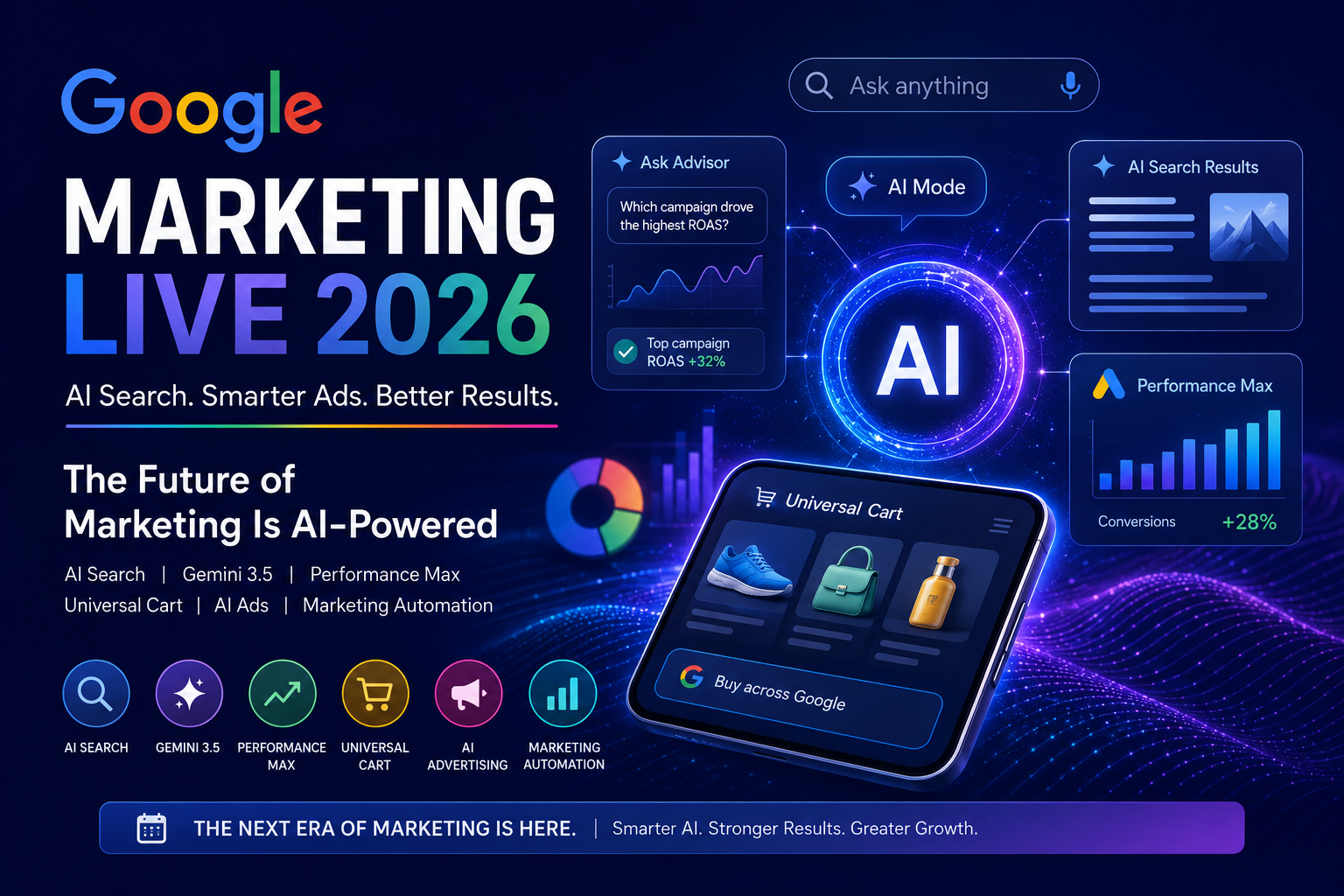
Google Marketing Live 2026: AI Search, Advertising & Marketing Automation Explained
Back to Blog AdTech & AI Google Marketing Live 2026: Complete Guide to AI Advertising, Search & Marketing Automation May 28, 2026 12 min read